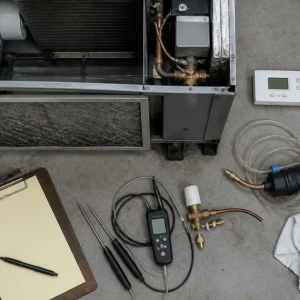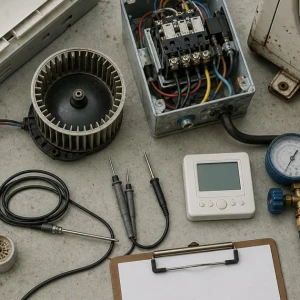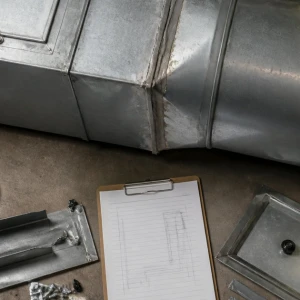


Commercial air balancing and TAB testing measure how an air system actually delivers supply, return, exhaust, and transfer air under defined operating conditions. ClimateService supports authorized Chicago facilities with testing, adjusting, and balancing work that has a clear basis, accessible adjustment scope, and documented results. TAB does not replace generic diagnostics, full commissioning, ventilation design, equipment repair, or a compliance certification outside the authorized project.
Define the purpose and balancing basis
The project identifies systems and areas, design or approved target data, drawings, schedules, occupancy, operating modes, recent changes, known complaints, required deliverables, and responsible acceptance. Without a credible basis, measurements can describe current air but cannot prove alignment with intent. Missing design information is documented and may require owner or engineering direction before adjustment.
Confirm equipment is ready for TAB
Fans, drives, belts where present, motors, filters, coils, dampers, access doors, controls, safeties, ductwork, terminals, fire and smoke interfaces, and ventilation equipment should be complete and available. Dirty filters, failed fans, closed valves, frozen coils, disconnected ducts, or unresolved controls can invalidate readings. Readiness deficiencies are recorded rather than balanced around as permanent conditions.
Establish stable test conditions
Operating mode, fan command, speed, drive frequency, filter state, doors, windows, exhaust systems, make-up air, outdoor conditions, occupancy, ceiling access, and space configuration influence measurement. The technician records these conditions and avoids mixing results from incompatible states. Intermittent control changes or occupied interference may require a coordinated window or repeated observations.
Measure fan and main-system performance
Fan identification, rotation, speed, drive condition, current where in scope, inlet and discharge conditions, total or static pressure, available test ports, airflow method, system effect, and control setpoint are reviewed. A fan nameplate is not a field reading. Main-system evidence helps determine whether branch adjustment is possible or whether equipment and duct conditions first need correction.
Traverse ducts where the system permits
Duct traverses require suitable straight sections, access, instrument selection, point placement, area, density considerations where relevant, and stable flow. Poor locations can produce misleading averages. Other accepted methods may be used according to scope. The report states method and limitations so downstream totals are not presented with greater certainty than the available test conditions support.
Measure supply, return, and exhaust terminals
Diffusers, grilles, registers, hoods, branches, terminal devices, and return or exhaust openings are identified and measured with suitable instruments. Terminal type, correction factors, placement, swirl, obstruction, leakage, access, and room condition affect readings. Results are checked for practical consistency with upstream flow and system relationships rather than copied without reconciliation.
Adjust in a controlled sequence
Fan capacity, main branches, sub-branches, terminal dampers, balancing devices, and control settings are addressed in an order that respects system interaction. Closing one path changes others. Adjustments remain within equipment, noise, pressure, ventilation, and control constraints. Permanent settings are marked or recorded where appropriate, and controls overrides are restored after tests.
Protect required ventilation relationships
Supply, return, exhaust, transfer, make-up air, and building pressure interact. Air-distribution TAB measures these relationships, while ventilation design and specialized pressure ownership remain in their branch. Kitchen, laboratory, healthcare, or other critical applications may require additional responsible parties and criteria. This service does not promise regulatory compliance from airflow readings alone.
Investigate totals that do not reconcile
Leakage, disconnected or hidden branches, inaccessible dampers, poor test locations, terminal correction, door position, unmeasured transfer, fan instability, controls, duct restriction, and measurement uncertainty can create mismatched totals. The technician checks likely causes and states unresolved differences. Forcing terminal numbers to add up on paper does not improve physical distribution.
Connect measured air with space complaints
Room use, load, thermostat location, supply pattern, return path, partitions, doors, solar exposure, equipment capacity, and control sequences affect comfort beyond air quantity. TAB can confirm distribution and make accessible adjustments, but it does not claim that airflow alone owns every temperature or humidity issue. Related equipment or building causes are routed clearly.
Repeat final readings after interaction settles
Final verification records fan and control state, pressure, branch quantities, terminal quantities, return and exhaust relationships, damper positions, limitations, and representative space observations after adjustments stabilize. Significant changes are rechecked upstream and downstream. Weather, access, occupancy, incomplete systems, or unavailable modes are named rather than omitted from the final report.
Deliver a traceable TAB record
ClimateService documents project basis, systems, instruments, test conditions, fan data, pressure, traverses or methods, terminal readings, adjustments, final values, restored controls, readiness deficiencies, inaccessible points, uncertainty, unresolved discrepancies, space context, and open equipment or ventilation work. Facility teams receive measured evidence that can support acceptance, correction, and future comparison.