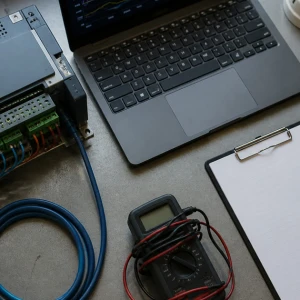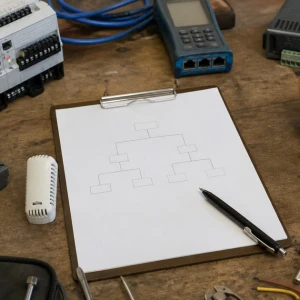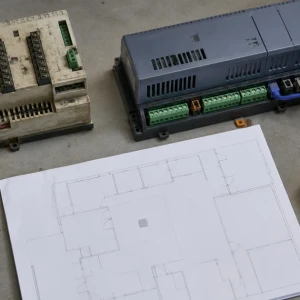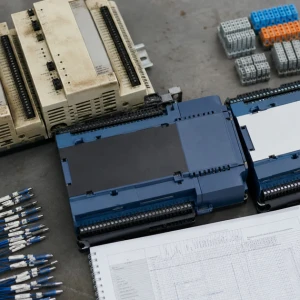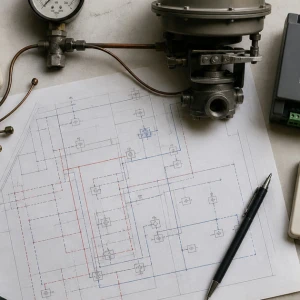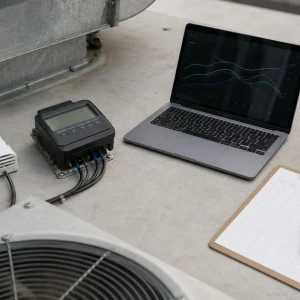


Commercial HVAC controls integration connects equipment, field devices, local controllers, supervisory automation, operators, and documented sequences into one testable operating relationship. ClimateService supports authorized Chicago projects where new or existing HVAC assets must exchange commands, status, alarms, and operating data with a BAS or BMS. The work is distinct from routine BAS service, generic mechanical installation, broad retrofit, or diagnosis of an isolated failed sensor.
Define the integration boundary before wiring begins
The project should identify each equipment item, serving relationship, local controller, required interface, responsibility split, approved sequence, point owner, electrical and communication boundary, network stakeholder, and acceptance requirement. A rooftop unit with a factory controller needs a different approach from a field-controlled air handler. Clear boundaries prevent duplicate logic, competing commands, missing safeties, and late scope disputes.
Build a point map that operators can trust
Commands, setpoints, modes, temperatures, humidity, pressure, airflow, valve and damper positions, fan or pump status, alarms, safeties, maintenance values, and calculated points should have names, units, ranges, writable status, update behavior, and source. Point mapping is not a bulk import exercise. Each item must support the approved sequence, diagnostics, operator use, or required record.
Choose the correct physical interface
Hardwired inputs and outputs, relays, transducers, current switches, sensors, actuators, variable-frequency-drive interfaces, and communication gateways each carry different failure modes and responsibilities. Voltage, signal type, scaling, isolation, shielding, grounding, routing, and environmental conditions matter. The selected interface should preserve equipment protection and provide enough feedback to distinguish a command from actual operation.
Coordinate native and supervisory control
Packaged units, chillers, boilers, VRF systems, refrigeration equipment, drives, and plant controllers may retain critical local logic. The BAS should request modes and setpoints within an approved boundary rather than overwrite internal safeties or unstable loops. Integration documents which layer owns staging, reset, enable, alarms, lead-lag, proof, and shutdown so two controllers do not fight for the same result.
Translate sequences into testable states
A sequence needs prerequisites, commands, feedback, timing, limits, resets, staging, alarms, safeties, fallback states, recovery behavior, and operator permissions. ClimateService reviews how the written intent reaches actual devices and equipment. Ambiguous language is resolved with the owner or responsible designer before programming. Functional tests then use defined states instead of informal claims that the system appears to run.
Create graphics for operation, not decoration
Useful graphics show equipment relationships, current mode, commands, status, critical values, setpoints, alarms, overrides, navigation, and trend access without hiding important conditions behind visual clutter. Colors and symbols need consistent meaning. A polished image cannot compensate for incorrect point bindings, stale data, or missing feedback, so each displayed value is verified against its source and field response.
Configure alarms and histories during integration
Alarm conditions, delays, priorities, routes, acknowledgments, enable logic, and recovery states should reflect operating consequence. Trends need selected points, units, intervals, retention, timestamps, and enough context to evaluate the sequence. Excessive collection can be as unhelpful as missing history. The integration plan focuses records on troubleshooting, verification, maintenance, and operator decisions.
Protect access, backups, and network ownership
Controller programs, databases, graphics, gateway settings, addressing, licenses, and configuration archives should be preserved at defined milestones. Authorized accounts and roles support testing and turnover. Enterprise networking, remote-access policy, firewall rules, cybersecurity, and credential governance remain with responsible parties. Integration coordinates requirements without silently changing infrastructure outside the approved HVAC controls scope.
Test from command to occupied result
Point-to-point checks confirm wiring and values; functional tests confirm sequence. A complete path may include schedule, enable, controller output, relay, drive, actuator, equipment stage, proof, distribution, zone result, alarm, shutdown, and restart. Representative load and weather may limit certain tests. Deferred states receive named conditions, expected readings, responsible observers, and a follow-up route.
Plan cutover around operating consequences
Integration can affect many zones or shared plant assets. The cutover plan addresses backups, existing operating state, temporary control, electrical isolation, network change windows, tenant or process needs, life-safety boundaries, rollback, communication, and restoration. Phased work may be appropriate when the facility cannot accept a single broad interruption or when retained systems require interim interfaces.
Train operators on decisions they actually make
Turnover should explain navigation, modes, schedules, setpoints, alarms, trends, overrides, common fault boundaries, approved adjustments, escalation, and backup location. Training uses installed equipment and real sequences rather than a generic software tour. Operators should understand what the BAS controls, what remains local, and what physical checks are needed before a screen command is treated as proof.
Close the project with integration evidence
ClimateService documents equipment and point scope, interfaces, approved sequences, controller and network boundaries, final programs and backups supplied, graphics, alarms, trends, test results, deferred conditions, restored overrides, operator turnover, limitations, and open work within its role. The result is an integration that can be operated and serviced, not merely a connection that exchanged data once.