

Knowing when to replace a commercial HVAC system is a risk and ownership decision. Equipment age matters, but it cannot explain current condition, failure consequence, repair history, parts availability, controls, energy use, building changes, or capital timing by itself. ClimateService helps Chicago facility and property teams organize HVAC evidence so replacement can be planned before an avoidable emergency dictates the schedule.
Start with the consequence of losing the system
The same mechanical condition can carry very different business risk. A unit serving a vacant support area is not equivalent to equipment serving tenants, technology, inventory, health-sensitive spaces, kitchens, or processes. Identify affected areas, acceptable outage duration, seasonal exposure, redundancy, temporary options, tenant commitments, and who can authorize an operating response.
Condition should be based on observed evidence
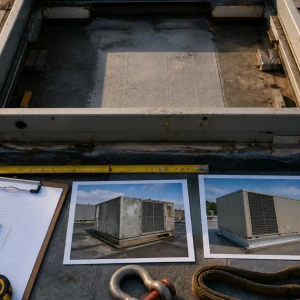
Coils, heat exchangers, compressors, motors, bearings, fans, piping, valves, cabinets, drains, insulation, electrical components, safeties, controls, and structural supports may age differently. Leaks, corrosion, vibration, contamination, damaged surfaces, recurring trips, and difficult access add context. An inspection records visible and testable conditions while distinguishing inaccessible or unverified components.
Service history reveals patterns that a snapshot misses
Review repeated failures, emergency calls, refrigerant additions, temporary repairs, control faults, unavailable components, after-hours labor, tenant complaints, and time spent diagnosing intermittent issues. Separate unrelated one-time events from recurring system patterns. A well-maintained older asset may remain predictable, while a newer but poorly matched or damaged system may create greater operating risk.
Parts and refrigerant constraints affect recoverability
A repair can be technically possible yet difficult to execute within the building’s required time. Component lead time, obsolete controls, proprietary boards, refrigerant availability, compatible replacements, specialized labor, and access influence restoration. These constraints should be verified for the specific asset. General statements about an equipment age or refrigerant do not replace current supplier and manufacturer information.
Performance must be compared with present requirements
Capacity, ventilation, humidity, zoning, schedules, internal loads, controls, acoustics, and distribution may no longer match the building. The problem may come from equipment, ductwork, piping, controls, envelope, operation, or a combination. Replacement is more defensible when the project distinguishes an asset failure from a system or building condition that new equipment alone will not correct.
Repair cost needs context rather than one ratio
Compare the proposed repair with probable follow-on work, remaining condition, failure consequence, downtime, efficiency, warranty, controls, code-driven scope, and planned use of the property. A low-cost repair may be valuable as a bridge to a coordinated capital project. A larger repair may be poor value if another known constraint is likely to end the asset’s service shortly afterward.
Energy use can support—but should not dominate—the decision
Utility history, runtime, controls trends, setpoints, occupancy, weather, ventilation, simultaneous heating and cooling, and maintenance condition affect consumption. Savings claims require an explicit baseline and assumptions. Replacement may improve efficiency, but correcting schedules, sensors, airflow, water flow, economizer operation, or damaged components may also be relevant. Avoid simple payback promises without suitable data.
Safety and compliance findings require responsible escalation
Unsafe electrical conditions, combustion concerns, structural deterioration, refrigerant issues, water damage, blocked access, and fire or life-safety interfaces may require immediate isolation or specialist review. ClimateService documents observations within its scope and identifies next steps. Code interpretation, engineering decisions, environmental work, and authority approval remain with qualified responsible parties.
Planned replacement preserves more choices
Early planning allows condition verification, load review, equipment comparison, utility and structural investigation, controls coordination, procurement, permits, tenant communication, lifting, and seasonal scheduling. Emergency replacement narrows these choices and can increase temporary measures. A capital window should include decision points and triggers so the owner knows when continued repair no longer matches the approved risk.
A decision record makes the recommendation usable
The record should summarize assets, present condition, observed limitations, service history, operating consequence, repair options, replacement dependencies, uncertainties, and recommended next action. It should distinguish facts from assumptions. Facility teams can then update the decision as new failures, bids, tenant requirements, or project information appear instead of restarting from an undocumented opinion.
ClimateService connects timing to an executable HVAC scope
ClimateService evaluates authorized commercial HVAC conditions and develops practical next steps for Chicago properties. When replacement is appropriate, the team can coordinate equipment interfaces, access, shutdowns, installation, controls, startup, and turnover. When more evidence is needed, the scope can begin with diagnostics or assessment rather than forcing a premature equipment decision.
The next step should name the asset, decision owner, required evidence, target date, operating constraint, and immediate risk control. That discipline turns a recommendation into work the facility can schedule, budget, and revisit as conditions change.