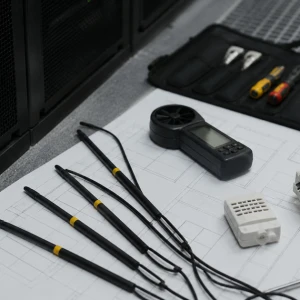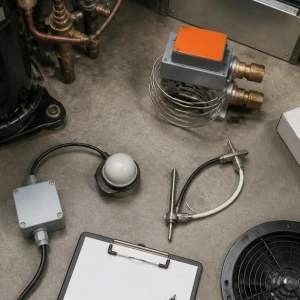


Commercial precision cooling service focuses on stable temperature, humidity where applicable, continuous airflow, staged capacity, alarms, and recoverability in protected technical environments. ClimateService supports authorized Chicago facilities by connecting close-control equipment with active load, supporting water or refrigerant systems, controls, drainage, and representative space conditions. Data-center facility context and CRAC/CRAH equipment language retain their own pages while generic comfort cooling stays outside.
Confirm that the system is precision cooling
Equipment design, served space, operating schedule, environmental criteria, sensible and latent load context, airflow arrangement, redundancy intent, alarm requirements, and continuous-duty expectations are reviewed. A tightly controlled room is not defined by its label alone. Conventional comfort equipment serving an office or small equipment room may require commercial repair rather than a precision-cooling owner.
Establish the authorized environmental basis
Facility-approved temperature and humidity ranges, sensor locations, alarm thresholds, trend interval, load pattern, operating modes, and escalation path establish acceptance. Universal values are not imposed. Sensor accuracy, placement, stratification, and local heat sources are considered before declaring a control failure. The record distinguishes the facility criterion from observed conditions and instrument uncertainty.
Map equipment and supporting utilities
Direct-expansion circuits, chilled-water coils, condensers, chillers, pumps, valves, heat rejection, electrical feeds, humidification, reheat where present, condensate, controls, remote alarms, and standby units can support precision operation. Shared dependencies are identified. The equipment cannot be evaluated as an isolated cabinet when a common valve, plant condition, power event, or sensor affects multiple units.
Inspect fans, filters, coils, and air paths
Filter loading and bypass, fan wheels, motors, drives, speed commands, vibration, sound, coil cleanliness, fins, valve or circuit response, supply and return openings, obstructions, leakage, and pressure relationships affect delivery. A running fan may still provide inadequate or misdirected airflow. Findings are connected to representative protected-space measurements.
Evaluate refrigeration or chilled-water performance
For DX equipment, circuit status, compressors, refrigerant indicators, metering, pressures and temperatures where authorized, condenser condition, and safeties are correlated. For chilled-water equipment, valve movement, water temperatures, pressure or flow evidence, coil condition, and plant availability are reviewed. System configuration and load guide conclusions; one reading is not generalized.
Control temperature and humidity together
Cooling stages, fan behavior, dehumidification, humidification, reheat where designed, sensor calibration, deadbands, simultaneous calls, condensate, door activity, outside-air influence, and room load can interact. Correcting temperature alone can destabilize humidity. Service follows the approved sequence and identifies when controls, humidification, envelope, or process operation owns the remaining condition.
Review local controls and alarm behavior
Setpoints, sensors, stage commands, fan control, lead-lag, safeties, alarm history, remote contacts, restart settings, overrides, and trend evidence are compared with physical action. Cooling service owns local equipment response. BAS integration, network communications, graphics, alarm routing, and supervisory programming move to Controls/BAS when they become the primary fault.
Inspect condensate and water-risk controls
Drain pans, traps, lines, pumps, float switches, humidifier drains, valve and piping leakage, insulation, floor sensors, containment, termination, and nearby sensitive equipment are reviewed. A minor drain problem can become an operational event in a technical room. Work defines isolation, water protection, cleanup, restoration, and monitoring before opening the system.
Perform work under continuity controls
Maintenance window, active load, available backup, isolation, temporary monitoring, rollback, security, dust and water control, tool accountability, communications, approval, restart sequence, and stop conditions are agreed. The procedure accounts for pressure and temperature changes when a unit is disabled. Unavailable redundancy becomes an explicit risk decision rather than an assumption.
Correct the confirmed precision-system fault
Authorized work may address filters, fans, motors, drives, sensors, controls, actuators, valves, condensate, humidification components, refrigeration parts, accessible wiring, or local settings. Evidence determines scope. Plant failures, network problems, major replacement, envelope work, or load redesign are routed to their accountable owners while the precision-cooling interface remains documented.
Verify environmental recovery and stability
Testing can include unit enable, stages, fans, coil or circuit response, supply and return conditions, temperature, humidity, condensate, alarms, shutdown, restart, standby transition where authorized, and trend stabilization. Representative locations and test duration are stated. Recovery at the controller sensor alone does not prove uniform protected-space conditions.
Deliver a close-control service record
ClimateService documents equipment identity, protected criteria, load context, supporting utilities, filters, fans, coils or circuits, temperature, humidity, airflow, controls, alarms, condensate, confirmed cause, completed work, change controls, tests, recovery, trends, limitations, open dependencies, and owners. The closeout names sensor locations, tested duration, active stages, available standby state, approved rollback decisions, responsible facility owner, and the exact operating condition required to finish deferred load verification. Facility teams receive a repeatable basis for monitoring, maintenance, CRAC/CRAH service, or capital action.