

Commercial packaged HVAC maintenance should preserve reliable heating, cooling, airflow, outdoor air, drainage, electrical operation, and controls as one coordinated system. Standard checklists miss differences in cabinet type, heat source, refrigeration stages, economizer, environment, schedule, and facility consequence. ClimateService builds authorized Chicago maintenance around actual equipment and creates a repeatable condition record that turns observations into owned action.
Inventory each unit and its served function
Record equipment identity, location, configuration, heat source, cooling stages, fan and drive, filters, economizer, controls, connected ducts, served spaces, occupancy schedule, criticality, access, and available documents. Similar cabinets can contain different components and sequences. A reliable program starts with the correct unit-to-space map.
Set frequency from use and exposure
Operating hours, outdoor dust, grease, cottonwood, construction, weather, snow, salt, roof or grade conditions, filter loading, humidity, occupancy, process load, and failure history influence intervals. Calendar service alone can be too frequent for one asset and too late for another. Condition evidence should adjust work while preserving manufacturer and owner requirements.
Protect cabinet, seals, and drainage
Panels, fasteners, hinges, door seals, insulation, partitions, base rails, pad or curb, corrosion, rain paths, penetrations, drain pan, trap, line, slope, heat trace where used, and surrounding debris affect the internal environment. Correcting small water and air leaks prevents electrical damage, insulation loss, microbial reservoirs, and uncontrolled outdoor air.
Maintain filters and airflow components
Filter type, size, fit, loading, racks, bypass, return path, supply path, blower wheel, motor, bearings, belts, sheaves, drive, dampers, vibration, and external static indicators should be reviewed. Filter changes must match facility needs without exceeding fan capability. Airflow degradation changes coil, heating, refrigeration, and comfort behavior.
Keep heat-transfer surfaces usable
Evaporator and condenser coils, fins, guards, surrounding clearance, condensate, outdoor debris, grease, corrosion, and cleaning access affect capacity. Cleaning method, pressure, chemistry, rinse, runoff, electrical protection, fin condition, and coatings should be compatible. Aggressive washing can damage fins, drive contamination deeper, or flood cabinet sections.
Review refrigeration condition without routine disturbance
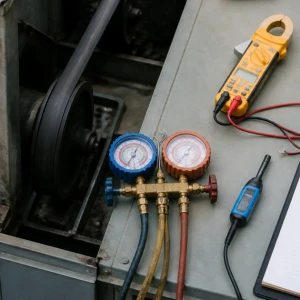
Compressors, piping, supports, insulation, oil evidence, coils, condenser fans, contactors, controls, safeties, temperatures, current, and operating response can reveal change. Refrigerant access and handling should be performed only when justified and authorized. Adding refrigerant as routine maintenance without leak or performance evidence is not sound practice.
Maintain the installed heating section
Gas, electric, heat-pump, or hydronic sections require different tasks. Inspection may involve heat exchangers, ignition, burners, safeties, combustion components, heaters, contactors, reversing valves, defrost, valves, pumps, venting, and airflow. Qualified personnel should follow applicable procedures; a cooling-season visit should not make heating readiness invisible.
Exercise economizer and ventilation operation
Outdoor-air hoods, screens, dampers, blades, linkages, actuators, minimum position, return path, relief, sensors, mixed-air control, schedules, interlocks, and physical movement deserve functional checks. A clean unit with a failed economizer can waste energy or lose ventilation. Building-wide BAS ownership remains separate from unit-level maintenance.
Inspect electrical and control condition
Disconnect, fuses, contactors, terminals, transformers, wiring, grounding, motor protection, capacitors where applicable, sensors, thermostats, controller, setpoints, schedules, alarms, safeties, variable drives, and overrides may be reviewed within scope. Heat, corrosion, looseness, moisture, and repeated protection events should route into corrective work rather than receive an automatic reset.
Use seasonal transitions as functional tests
Spring and fall service should verify the mode about to carry load while respecting weather limitations. Cooling, heating, fan, economizer, drainage, freeze protection, low-ambient controls, changeover, alarms, and representative zones may be exercised. Unavailable stages should be tagged for a later load condition instead of being recorded as proven.
Trend changes and route corrective scope
Filter loading, belt condition, vibration, current, temperature response, coil fouling, drain history, contactor wear, compressor behavior, heating condition, economizer movement, corrosion, and repeated alarms become more valuable across visits. Trends can route repair, cleaning, controls, duct, replacement, or capital planning with evidence and priority.
Keep consumables and access practical
Filter dimensions, quantities, efficiency, belt section, lubricant requirements, drain treatment if approved, fuses, and other routine materials should match the actual unit rather than a generic list. Storage conditions and reorder points matter for facilities with many packages. Service clearances, panel removal, roof or yard access, keys, fall-protection coordination, and winter access should be resolved before the next visit, so routine work does not become an emergency logistics problem.
Turn maintenance observations into budget timing
Repeated corrosion, coil loss, compressor stress, blower wear, economizer failure, cabinet leakage, obsolete controls, or unavailable parts may exceed routine maintenance ownership. Condition records should show trend, operating effect, likely next action, urgency, access cost, and responsible reviewer. That information supports repair or replacement decisions without converting every recommendation into a sales claim.
ClimateService provides a usable maintenance handoff
ClimateService records completed tasks, observed conditions, measurements, operating modes, photographs, corrected minor items, unavailable checks, open recommendations, priority, responsible trade, and next timing within its scope. Facility teams receive unit-specific continuity rather than a checked box, while energy, compliance, capacity, and remaining-life claims stay limited to verified evidence.