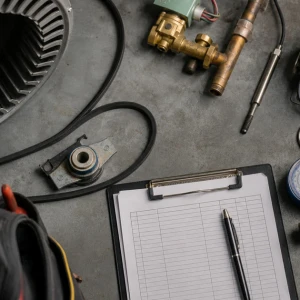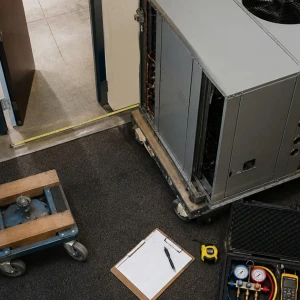


Commercial self-contained HVAC maintenance preserves an indoor package and the building systems that allow it to reject heat, move air, drain water, receive utilities, and follow controls. Cabinet-only checklists can miss condenser-water degradation, duct restrictions, room conditions, or shared-loop changes. ClimateService structures authorized Chicago maintenance around equipment configuration, actual use, facility consequence, and traceable condition trends.
Create an accurate equipment and zone register
Document cabinet identity, location, served rooms or floors, configuration, cooling circuits, heating or reheat, fan and drive, filters, heat rejection, water valves and strainers, drainage, controls, schedule, criticality, access, and available manuals. The register prevents confusion when similar units serve different tenants or depend on different loop branches.
Set intervals from operation and environment
Hours, occupancy, internal load, filter loading, mechanical-room dust and temperature, water quality, loop season, humidity, drain history, construction, failure pattern, and consequence should influence frequency. Calendar visits remain useful, but observations should adjust filter, cleaning, lubrication, strainer, and functional-test timing without discarding approved requirements.
Maintain the room and cabinet boundary
Service clearances, lighting, housekeeping, ventilation, floor drains, leaks from adjacent systems, storage, access doors, panels, seals, insulation, corrosion, vibration isolation, and base condition affect serviceability. Blocked panels or a hot, wet room can shorten component life and turn routine tasks into disruptive work.
Protect airflow and distribution
Filter type, fit, loading, racks, bypass, return or plenum, blower wheel, bearings, motor, belts, sheaves, drive, coils, dampers, supply ducts, external static, terminals, and zone return paths should be reviewed. Trends in filter pressure, belt wear, vibration, or temperature response can reveal developing distribution issues.
Review refrigeration condition with minimal disturbance
Compressors, piping, insulation, oil evidence, evaporator and condenser condition, contactors, safeties, temperatures, current, sound, vibration, and stage response may show change. Refrigerant access is justified by evidence and authorization, not performed automatically at every visit. Airflow and heat rejection should accompany refrigeration interpretation.
Maintain condenser-water interfaces
Valves, actuators, strainers, hoses or piping, insulation, leaks, entering and leaving temperatures, flow indicators, pressure where available, pumps, tower or loop status, treatment information, and control sequence influence water-cooled equipment. Mechanical maintenance should coordinate with plant and treatment providers while keeping ownership boundaries explicit.
Keep drainage and moisture controlled
Pans, traps, lines, pumps, cleanouts, slope, insulation, sweating, coil icing evidence, humidification where present, floor drains, and leak sensors need configuration-specific attention. Cleaning methods should protect occupied areas and building materials. Persistent water should route into cause-based repair rather than receive repeated vacuuming.
Inspect heating and reheat systems
Electric heaters, hot-water or steam coils, heat-pump components, valves, actuators, contactors, limits, safeties, pumps, venting where applicable, airflow, sensors, and stages should be checked for the installed design. Seasonal readiness requires a functional mode test when conditions permit, with unavailable modes recorded for follow-up.
Exercise controls and protective sequences
Thermostats, sensors, schedules, setpoints, fan command, stages, water valves, drives, safeties, alarms, interlocks, BAS points, overrides, and restart behavior should be compared with physical response. Building-wide automation programming remains separate, but unit maintenance should not ignore commands that undermine sound mechanical operation.
Coordinate shared-loop and seasonal transitions
Loop temperature changes, tower or heat-rejection availability, pump staging, valve position, treatment restoration, winter operation, free cooling where applicable, and simultaneous tenant demand can affect self-contained units. Maintenance records should identify central conditions so a building-level issue is not repeatedly assigned to individual cabinets.
Trend findings into corrective ownership
Filter loading, belt condition, vibration, current, air response, coil fouling, drain events, compressor starts, water temperatures, valve movement, contactor wear, sensor drift, corrosion, and alarms become valuable across visits. Findings should route into cabinet repair, water-loop work, controls, ducts, treatment, cleaning, or capital planning with priority.
Standardize consumables without hiding equipment differences
Filter dimensions, quantities, efficiency, belt section, lubrication, strainers, drain accessories, fuses, and other routine materials should be tied to each cabinet. Consolidated inventory can reduce delays, but a substitute should not be installed merely because it fits the storeroom. Reorder points should reflect unit criticality, lead times, storage conditions, and the building's ability to carry an outage.
Keep access and tenant coordination ready
Keys, escorts, elevator reservations, floor protection, tenant notice, after-hours rules, water isolation contacts, BAS access, mechanical-room clearance, and central-plant coordination should be maintained as part of the program. These details do not service a compressor, but they determine whether approved work can begin before a small condition becomes an occupied-space interruption.
ClimateService provides continuity for facility teams
ClimateService records tasks, conditions, readings, active modes, photographs, corrected minor items, unavailable tests, shared-system context, recommendations, responsible trade, and next timing within its scope. Facility staff receive a unit and zone history that reduces rediscovery, while maintenance remains risk reduction rather than a guarantee against every utility, plant, component, or controls failure.