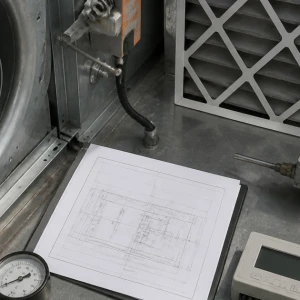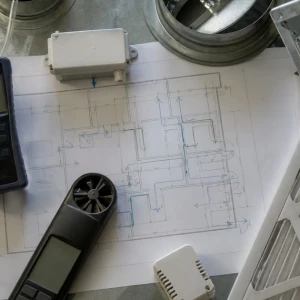


Commercial exhaust fan and exhaust ventilation service maintains the air-removal path from a served space through grilles, ducts, dampers, fans, controls, and discharge. ClimateService supports authorized Chicago buildings outside restaurant kitchen-specific ownership and connects exhaust performance with replacement air, building pressure, schedules, and occupied use. Ductwork-first repair, TAB, process design, and broad capital replacement retain separate owners when primary.
Identify the exhaust purpose and served area
Restroom, storage, mechanical, garage, general process, janitorial, utility, or other commercial exhaust has different operating needs and boundaries. The service maps grilles, branches, ducts, dampers, fan, discharge, controls, schedule, interlocks, affected spaces, and complaint. It also confirms whether the request belongs to general exhaust or to a specialized process or kitchen system requiring another owner.
Inspect fan access and external condition
Roof, wall, inline, or cabinet fans require safe access, supports, curbs, flashings, weatherhoods, guards, housings, access panels, vibration isolation, flexible connections, and service clearance. Corrosion, water entry, loose panels, debris, damaged screens, or unstable supports can affect operation. Roofing and structural boundaries are documented and coordinated rather than treated as fan components.
Test wheel, motor, and drive performance
Wheel or blade condition, rotation, set screws, balance, bearings where serviceable, motor, belts, sheaves, direct drive, variable-frequency drive, mounts, vibration, sound, current, speed, airflow direction, and safeties are evaluated. A running motor can drive a slipping belt or dirty wheel with little useful airflow. Speed changes respect motor, fan, duct, noise, and pressure limits.
Check dampers and gravity devices
Backdraft, control, isolation, smoke or fire interfaces, louvers, shutters, actuators, linkages, blades, bearings, seals, weights, end switches, and physical movement are observed where accessible. Stuck shutters can mimic fan failure. Fire and smoke acceptance remains with responsible life-safety parties, and those devices are not altered casually during ventilation service.
Trace airflow through grilles and ducts
Blocked grilles, dirty screens, disconnected ducts, collapsed or restricted sections, closed dampers, leakage, poorly placed branches, internal debris, and inaccessible transitions can reduce removal. Exhaust service verifies the immediate path and system relationship. Physical duct repair routes to Air Distribution/DX when that becomes the dominant scope; system-wide balancing routes to TAB.
Review controls, schedules, and proof
Occupancy schedules, local switches, sensors, fan commands, starters, relays, drives, current or pressure proof, alarms, interlocks, BAS points, shutdown, and restart are compared with physical operation. A command does not prove rotation or airflow. Controls-first network and programming work receives a clear handoff once the fan and field boundary are tested.
Evaluate discharge and re-entry risk
Outlet condition, weatherhoods, caps, screens, clearances, wind, nearby intakes, openings, occupied areas, roofs, snow, grease or process residue, and plume behavior where relevant influence discharge. Design and environmental criteria remain with responsible parties. Service documents obvious recirculation or obstruction and avoids relocating discharge without an approved project scope.
Connect exhaust with replacement air
Make-up air, outside-air systems, supply and return, transfer paths, doors, shafts, docks, stack effect, wind, and other exhaust fans shape building pressure and available airflow. An exhaust fan may be healthy but starved for replacement air. The investigation records simultaneous operating states so fan performance is not judged with the building configured differently from normal use.
Distinguish general exhaust from specialized needs
Controlled environments, hazardous or process exhaust, healthcare or laboratory systems, garages, kitchens, and other applications may have specific design, monitoring, capture, filtration, and compliance requirements. This page owns general commercial exhaust service. Specialized criteria are not invented or certified from a routine fan visit and receive the correct responsible scope.
Repair the verified exhaust boundary
Authorized correction may include cleaning accessible components, wheel or blade work, belts, sheaves, bearings where serviceable, motors, drives, mounts, controls, sensors, relays, dampers, shutters, flexible connections, guards, and immediate duct connections. Equipment replacement, structural curbs, roof work, extensive duct repair, electrical upgrades, and system redesign are separated when they exceed service scope.
Verify removal under representative conditions
Testing can include rotation, speed, vibration, sound, current, controls, proof, dampers, grilles, airflow, pressure, discharge, make-up-air relationship, doors, alarms, shutdown, restart, and served-space observations. Exact quantities require an approved TAB scope when applicable. Weather, occupancy, other fans, and unavailable process states remain stated limits.
Receive an exhaust-system closeout
ClimateService documents purpose, served area, system map, access, fan and drive condition, dampers, ducts, controls, discharge, replacement air, pressure context, confirmed cause, completed work, final tests, restored settings, life-safety and specialized boundaries, limitations, open roof or duct interfaces, and follow-up. The record explains actual air removal, operating relationships, seasonal limits, stable test conditions, and responsible monitoring rather than reporting only that the motor ran.