

Commercial make-up air unit service maintains the equipment and control path that brings replacement air into a building when exhaust or process operation removes air. ClimateService supports authorized Chicago facilities by tracing intake, filters, dampers, fan, coils or heat sections where present, controls, safeties, discharge, exhaust relationships, building pressure, and occupied results. Kitchen-industry systems remain separate when the foodservice process is primary.
Identify what the make-up air replaces
The service map connects the MUA unit with exhaust fans, process or general exhaust, served spaces, operating schedule, interlocks, occupied use, doors, loading docks, and pressure complaints. A running unit may still supply too little, too much, or untempered air. Understanding the exhaust relationship prevents a fan problem from being diagnosed without the system it is intended to balance.
Inspect the outdoor-air intake
Louvers, screens, hoods, bird screens, snow or rain entry, debris, nearby exhaust discharge, vehicle or process sources, damper position, access, and weather exposure are checked. Restricted or contaminated intake conditions can affect airflow and IAQ. Building placement and source-control issues are documented for responsible review rather than corrected through filter changes alone.
Evaluate filters and internal airflow
Filter type, fit, loading, bypass, racks, pressure relationship, cabinet leakage, internal obstructions, fan inlet, discharge, and access doors influence delivery. Replacing filters without checking fit or pressure can leave bypass or overload the fan. The service records the installed condition and whether additional design or procurement information is needed for a supported filter strategy.
Test fan, motor, and drive operation
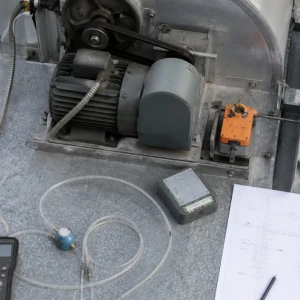
Fan wheel or blades, rotation, motor, bearings where serviceable, belts and sheaves where present, direct drive, variable-frequency drive, mounts, vibration, sound, current, speed command, airflow direction, and safeties are correlated. A speed increase is not the default correction. Duct pressure, filters, exhaust demand, noise, motor limits, and building response constrain adjustment.
Check dampers and outside-air control
Intake and discharge dampers, actuators, linkages, blades, seals, end switches, minimum or commanded position, freeze or low-limit logic, interlocks, and feedback are compared with physical movement. A controller can show open while a loose linkage leaves blades closed. Binding or damaged dampers can also overload actuators and reduce replacement air.
Assess heating or cooling tempering sections
Coils, burners or heat sections where applicable, valves, refrigerant components, heat exchangers, pumps or central-source interfaces, ignition and combustion boundaries, freeze protection, drains, sensors, safeties, and entering and leaving air follow the installed design. This is not a furnace-first page. Any heat section is treated as one component of the ventilation equipment and tested under qualified procedures.
Verify schedules, interlocks, and safeties
Occupancy schedule, exhaust proof, fan command, damper proof, temperature limits, freeze protection, smoke or life-safety interfaces, pressure control, alarms, shutdown, and restart are checked within authorized boundaries. Life-safety acceptance and BAS programming remain with responsible owners. Temporary overrides are recorded, limited, restored, and never used to defeat protection.
Inspect discharge and distribution interfaces
Duct connections, flexible connectors, supports, insulation, leakage, access, dampers, terminals, diffuser pattern, drafts, short-circuiting, and served-area delivery affect usefulness. Ductwork-first repair and TAB route to Air Distribution/DX when they own the need. MUA service verifies the unit and immediate pathway far enough to prove or route the distribution boundary.
Measure the relationship with exhaust and pressure
Unit airflow, exhaust operation, doors, transfer paths, supply and return, stack effect, wind, loading docks, and occupied modes influence pressure. One doorway reading under an unrepresentative condition is not a complete conclusion. Service records operating state and uses representative pressure or airflow evidence to determine whether equipment, control, distribution, or wider building coordination is needed.
Plan service for weather and occupied operations
Roof access, wind, snow, rain, heat, electrical isolation, exhaust shutdown, tenant or process needs, doors, lifts, security, noise, filters, water, ceiling work, and restoration affect execution. MUA failure may change exhaust performance and pressure across several areas. The plan identifies reach and avoids leaving the building dependent on an undocumented manual condition.
Verify replacement-air performance
Testing may include intake, filters, dampers, fan, motor or drive, airflow, tempering, controls, interlocks, safeties, discharge, exhaust relationship, pressure, alarms, shutdown, restart, and representative space conditions. Weather and load can limit heating or cooling proof. Deferred states receive expected conditions, readings, responsible monitoring, and response thresholds.
Receive an MUA-specific service record
ClimateService documents unit identity, exhaust and space relationship, complaint, schedule and weather, intake, filters, dampers, fan, drive, tempering, controls, safeties, discharge, airflow and pressure evidence, confirmed cause, completed work, final tests, restored overrides, limitations, open duct or building interfaces, and follow-up within scope. The record also preserves seasonal test needs and responsible monitoring conditions.