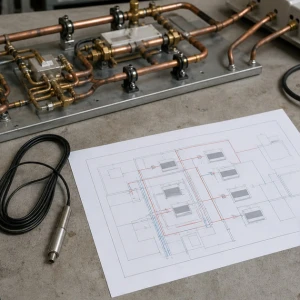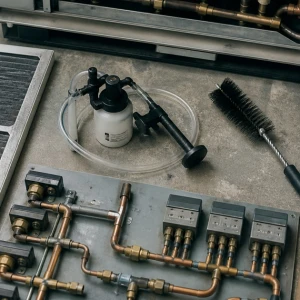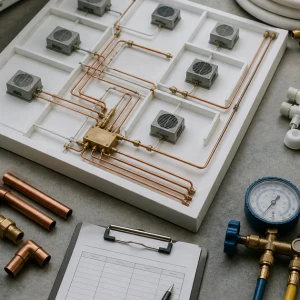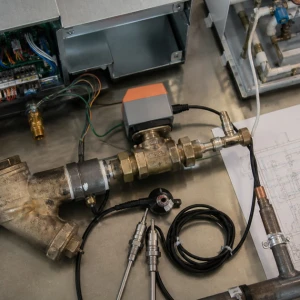


Commercial VRF and VRV replacement or upgrade is a connected-system decision. Outdoor modules, indoor units, branch controllers, refrigerant type and charge, piping, communication, controls, condensate, electrical service, building zones, and occupied operations may not be replaceable one component family at a time. ClimateService develops authorized Chicago mechanical scope from verified condition and compatibility evidence while design and other responsibilities stay assigned.
Confirm why modernization is needed
Review failure history, refrigerant leaks, compressor and board condition, communication stability, parts and software support, indoor-unit deterioration, branch devices, piping, capacity, comfort, controls, service access, repair cost, downtime, owner horizon, and future space plans. Age alone is not sufficient, but repeated failures across shared assets can make isolated repair poor value.
Map the installed generation and network
Identify every outdoor module, indoor unit, branch or selector device, refrigerant circuit, controller, gateway, address, served space, pipe relationship, electrical feed, drain, and available model or commissioning record. Unknown or mislabeled field conditions can turn a partial upgrade into an incompatible or untestable project.
Evaluate reuse through written compatibility
Indoor units, branch devices, piping sizes and limits, oil, insulation, controllers, communication, sensors, wiring, drains, supports, and refrigerant may or may not work with a newer generation. Manufacturer and qualified design guidance should support reuse. Physical connection or similar appearance does not prove protocol, pressure, material, or performance compatibility.
Revisit loads, zones, and operating goals
Occupancy, tenant changes, envelope, internal equipment, schedules, outdoor air, humidity, simultaneous heating and cooling, noise, criticality, future buildouts, and complaint history may differ from original design. Modernization should correct verified current needs rather than reproduce obsolete connected capacity and zoning without review.
Assess refrigerant piping integrity and access
Pipe sizes, lengths, elevation, supports, insulation, shafts, branch fittings, joints, selector locations, oil evidence, leak history, pressure testing feasibility, cleaning or flushing requirements, and concealed access influence reuse. A shared network with unresolved leaks or unknown contamination should not be hidden behind new outdoor modules.
Plan controls and communication migration
Local and central controllers, addresses, topology, gateways, schedules, locks, alarms, BAS integration, mode arbitration, trend history, network segmentation, and software access require a migration path. Temporary coexistence between generations must be supported. Backups, point mapping, naming, testing, and rollback should precede removal of working controls.
Compare full and phased replacement
A full project can simplify compatibility and commissioning but increase outage and capital demand. Phased work can protect operations yet introduce temporary interfaces, repeated access, limited redundancy, mixed controls, and longer risk. Compare zones, seasons, shared circuits, parts support, temporary conditioning, labor duplication, and final architecture on the same basis.
Coordinate refrigerant recovery and environmental scope
System charge, recovery, storage, reuse where permitted and approved, disposal, oils, pressure, isolation, leak repair, piping opening, testing, evacuation, dehydration, and final charging require qualified procedures and records. Environmental and regulatory ownership should remain explicit. Charge assumptions should follow installed volumes and approved manufacturer methods.
Protect occupied areas during removal and access
Ceiling openings, branch boxes, indoor units, furniture, finishes, tenants, lifts, noise, dust, refrigerant piping, drainage, electrical isolation, roof access, rigging, temporary conditioning, work hours, and restoration require a zone-by-zone plan. A shared system can extend shutdown beyond the room containing visible work.
Install with a clean new baseline
New equipment, retained components, piping tests, joints, insulation, supports, valves, drains, wiring, communication, addresses, controller databases, labels, access, and photographs should reflect the approved architecture. Old undocumented overrides, abandoned devices, and duplicate names should not be carried forward as hidden commissioning problems.
Commission migration and final operation
Checks may include system mapping, pressure and evacuation records, charge, communication, indoor units, drains, branch devices, outdoor modules, heating, cooling, heat recovery, defrost, controllers, BAS points, alarms, simultaneous zones, and representative spaces. Each phase needs acceptance plus final integrated testing.
Plan spares and support for the transition
Boards, controllers, sensors, branch devices, fan motors, drain pumps, filters, and other critical components can have different lead times across generations. The owner should know which retained assets are approaching support limits, which new parts are stocked or readily available, who holds software access, and how a failed mixed-generation interface will be handled during phasing.
Train operators on what changed and what remained
Facility staff should receive revised zone maps, controller hierarchy, schedules, mode rules, alarms, retained components, temporary limitations, maintenance locations, and shutdown contacts. Training should identify interfaces that no longer behave like the old system. Clear ownership protects the new baseline from inherited overrides and prevents retained equipment from disappearing from future maintenance.
ClimateService transfers a supportable modernized system
ClimateService documents condition basis, reuse decisions, installed and retained assets, piping and refrigerant records, control migration, settings, photographs, test results, phased limitations, open items, warranties, maintenance access, and seasonal follow-up within its scope. Facility teams receive a reliable ownership baseline rather than a mixed-generation system nobody can confidently map.