
A house that stays warm while the air conditioner runs has one of four causes: the equipment has lost capacity, the airflow path is restricted, the controls are calling incorrectly, or the system was never sized for the load it carries. Each cause leads to different work and a different page. The table below matches the situation to the service that owns it.
Which Cooling Path Fits the Situation
Symptoms rarely name the failed part. What they do narrow is the kind of visit required, and that is enough to start in the right place.
| What you are seeing | Where it belongs | What the visit covers |
|---|---|---|
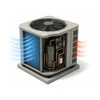
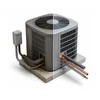
| Cooling is weak, or the outdoor unit starts and stops in short bursts | Central AC repair and maintenance | Refrigerant charge and leak search, condenser electrical components, coil and condensate condition |
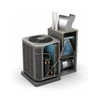
| The system is near the end of its service life, or it never kept up in July | Central AC installation | Manual J load calculation, AHRI matched pair selection, permit and commissioning |
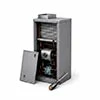
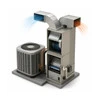
| Neither heating nor cooling behaves, and both run through the same ducts | Whole-system HVAC repair | Blower, control board, thermostat and duct faults shared by both seasons |
| Both sides of the system are being replaced in one project | Whole-system HVAC installation | One sizing pass across heating and cooling, electrical service, duct rework |
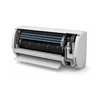
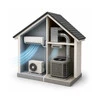
| Rooms with no ductwork need cooling: an addition, an attic, a converted porch | Ductless mini-split installation | Head placement, line-set routing, single-zone or multi-zone decision |
| An existing mini-split cools poorly, leaks water or reports an error code | Ductless repair and maintenance | Inverter and communication faults, indoor head cleaning, drain and line-set checks |
| Some rooms overshoot and others never arrive, while the equipment tests fine | Zone control systems | Zone panel logic, damper operation, static pressure and airflow balance |
Ducted and Ductless Answer Different Questions
A ducted system moves conditioned air through a single distribution tree, so its capacity is limited by what the ducts can carry. Static pressure and CFM at the registers decide how much of the nameplate tonnage actually reaches a room. A ductless system skips that tree entirely: each indoor head conditions the space it hangs in, and capacity is set per room.
That difference drives the choice more than efficiency numbers do. A house with sound ducts and one problem room is usually a distribution question. A finished attic with no duct path to it is a ductless question, because adding a branch to a system already running near its pressure limit takes capacity away from every other room.
What a Load Calculation Changes About the Result
Equipment is selected from a Manual J load calculation, which works from the building itself: orientation, glazing, insulation, infiltration and the floor area actually being conditioned. The output is a BTU load, and tonnage follows from it.
Oversizing is the common failure. A unit with more capacity than the house needs satisfies the thermostat quickly and shuts down before the coil has run long enough to pull moisture out of the air, which leaves a house that reads cool on the thermostat and feels damp. Short cycles also add start events to a compressor, and starts are what wear it.
Rated efficiency behaves the same way. SEER2 and EER2 describe a specific outdoor unit paired with a specific indoor coil, tested together and listed in the AHRI directory. A new condenser bolted to an old coil is a different assembly, and its real performance is not the number on the box.
Refrigerant Rules Shape Repair and Replacement Choices
Systems installed over the last two decades in Chicago houses run mostly on R-410A. New equipment has moved to lower-GWP refrigerants, R-454B among them, which are classified A2L and carry different handling, leak-detection and service requirements. The two are not interchangeable in one circuit.
For a repair decision, this matters when a leak is found. Refrigerant is a sealed-loop working fluid, so a system that is low has lost it somewhere, and adding more without finding the leak repeats the visit. Recovery, evacuation and charging are EPA 608 work; our technicians hold EPA 608 Type II certification.
Airflow Is Measured, Not Assumed
Before a component is blamed, the air side gets numbers. Total external static pressure shows whether the blower is fighting the duct system. Delta-T across the evaporator coil shows whether the refrigerant circuit is doing its job at the airflow it is actually getting. Superheat and subcool separate a charge problem from a metering-device problem.
Filters belong in the same conversation. A higher MERV rating traps finer particles and costs more pressure drop, and a filter chosen for filtration alone can push a marginal duct system past what the blower can overcome. The date on the filter is worth knowing before the visit.
What Belongs to Heating and to Commercial Work
Cooling and heating share a blower, ducts and a thermostat, so the split is by the equipment that failed rather than by the season. Furnaces, boilers, water heaters and geothermal systems are covered on the heating side of the site. A mini-split running in heating mode stays here, because it is the same machine described on the ductless pages.
Rooftop units, chillers, walk-in refrigeration and building controls are commercial equipment and sit under commercial HVAC services. Everything listed above is written for a homeowner deciding about their own house in Chicago or one of the surrounding suburbs.
Where to Start by Symptom
- The outdoor unit is silent while the indoor blower keeps running. An electrical fault at the condenser is the usual starting point, and it belongs in a repair visit.
- Cooling faded gradually across a season instead of failing on one afternoon, which points at charge loss or a fouled coil.
- Water is pooling near the air handler: condensate drain first.
- Two rooms are always wrong while the rest of the house holds its setpoint. That is distribution, so zoning or a duct assessment comes before anything at the condenser.
- The system is past fifteen years and has needed a second repair this season, which moves the question from repair to replacement planning.
- An addition or a converted space has never been comfortable, and it was probably never counted in the original load calculation.
Emergency calls are taken around the clock, and same-day service is available when a slot is open. Before any visit, two things are safe to check and useful to report: the position of the thermostat switch and the date the filter was last changed.