
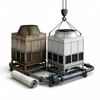
A commercial cooling tower rejects heat through the interaction of water distribution, airflow, evaporation, structure, drive components, basin, controls, and the connected condenser-water system. A tower complaint can originate in one component, but it can also be sustained by flow, chiller loading, sequence, water condition, or another plant dependency. Service starts by defining which boundary can explain the operating result.
Select the service by the decision the facility needs
Repair addresses a confirmed failure. Maintenance follows a recurring mechanical scope. Cleaning removes accessible debris and deposits within an agreed mechanical boundary. Restoration corrects multiple deteriorated conditions while retaining the basic asset. Rebuild or replacement changes a larger structural and mechanical scope. Fill, drift eliminators, basin, fan, motor, and gearbox work each require component-specific access and verification.
Water treatment, biological management, laboratory services, and regulatory compliance remain specialized responsibilities. Mechanical observations can be documented and coordinated with the facility’s qualified water-treatment provider without representing tower repair as a water-management program.
Describe the symptom in tower and plant terms
Useful intake identifies the tower type and cell, active load, water temperatures if reliably available, fan and pump status, visible overflow or leakage, vibration, noise, drift, uneven distribution, basin condition, alarms, controls state, recent work, and whether the chiller plant is affected. Photographs from safe locations can help establish the correct access and parts path.
Water distribution determines how the heat-transfer surface is used
Nozzles, headers, spray patterns, gravity distribution, flow, valves, strainers, and basin level can affect whether fill is wetted uniformly. Dry areas, channeling, blockage, damaged distribution components, or incorrect level may reduce effective heat rejection. Evaluation distinguishes a distribution problem from fill condition, airflow, load, or water-treatment issues.
Airflow depends on more than fan rotation
Fan blades, pitch where applicable, motor, belts or couplings, gearbox, bearings, shaft alignment, vibration, guards, louvers, fill condition, drift eliminators, obstructions, and recirculation can affect airflow. A running motor does not prove that the cell is moving the expected air safely and efficiently. Mechanical condition and controls command are compared with physical response.
Mechanical cleaning needs a defined boundary
A cleaning scope should identify accessible basin areas, strainers, distribution components, fill surfaces when appropriate, drift eliminators, debris removal, wash-water control, disposal responsibility, shutdown state, and protection of connected equipment. Some deposits cannot be removed safely or effectively without component removal or replacement.
Chemical cleaning, disinfection, treatment chemistry, and biological control require separate methods and qualified ownership. They should not be improvised inside a general mechanical cleaning visit.
Structural and basin conditions affect the repair path
Corrosion, coating failure, cracks, leaks, damaged fasteners, supports, framing, seams, drains, access platforms, and localized deterioration can change the scope. A basin repair may need dry access, surface preparation, cure conditions, water handling, and later leak verification. Structural concerns outside the mechanical service boundary may require an appropriate specialist.
Fill and drift eliminators are different components
Fill provides heat-transfer surface and water distribution through the air stream. Drift eliminators reduce entrained droplets leaving the tower. Damage, loading, collapse, poor fit, or material incompatibility can affect performance and serviceability in different ways. Replacement requires verified cell dimensions, support condition, material, access, removal path, and disposal.
Drive-system work requires alignment and operating proof
Fan, motor, belt, coupling, bearing, shaft, and gearbox service should address the confirmed component and the condition that loads it. Alignment, lubrication, supports, electrical supply, controls, vibration, blade condition, and rotation may influence the result. Replacing a drive component without checking its operating context can allow the same failure pattern to return.
Restoration, rebuild, and replacement need different scopes
Restoration can combine targeted mechanical and structural corrections while retaining the tower. A rebuild may replace major internal, casing, drive, distribution, or support assemblies. Replacement introduces rigging, structural, piping, electrical, controls, drainage, shutdown, capacity, permitting, and startup questions. Findings from a service visit can inform these decisions, but each capital option needs its own boundaries.
Verification follows the original tower problem
After service, checks may include water distribution, basin level and leakage, fan and drive operation, vibration observation, controls response, flow, temperature approach under available load, and interaction with the chiller plant. Full performance cannot be proven when weather or plant load is not representative; the handoff should state that limit.
Plan access and shutdown before field work
Tower cell isolation, lockout, roof or yard access, ladders or lifts, fall-protection requirements, water handling, drain path, weather, crane needs, adjacent operating cells, treatment-provider coordination, and an authorized facility contact affect the visit. The facility should identify redundancy and the operational consequence of removing one cell from service.
Choose the correct cooling tower resource
Dedicated pages cover repair, maintenance, mechanical cleaning, restoration, rebuild and replacement, fill media, drift eliminators, basin repair, fan and motor service, and gearbox repair. Chiller-only work remains under Commercial Chiller Services. This separation lets component and capital pages own their search intent without making the category page compete with them.
Request commercial cooling tower service
ClimateService provides commercial cooling tower service in Chicago and nearby suburbs. Share the tower type, cell designation, current symptom, plant impact, available temperatures or alarms, fan and pump state, recent work, treatment-provider contact, access, shutdown limits, and photographs when safely available. Clear plant context helps route the request to the right mechanical scope.