
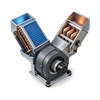
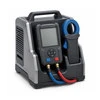
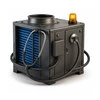
Some faults name their own system. A condenser that will not start in July is a cooling problem. Others do not: a house that is uncomfortable in both seasons, a blower that runs constantly, a thermostat that calls and gets nothing. Those come from parts both halves share, and the visit that finds them looks at the whole system before it looks at either end of it.
When the Symptom Does Not Name the System
Heating and cooling in a ducted Chicago house are two heat sources attached to one delivery system. The furnace or air handler holds the blower. The evaporator coil usually sits in the same cabinet. Both use the same supply and return ducts, the same filter, and the same thermostat and low-voltage wiring.
A fault anywhere in that shared layer produces symptoms in both seasons, and the season it is noticed in says nothing about where it lives. Weak airflow in August and weak airflow in January are the same measurement taken twice.
Shared Components That Fail for Both Seasons
| Component | How it fails | What it looks like in the house |
|---|---|---|
| Blower motor or wheel | Bearing wear, capacitor drift, dust loading on the blades | Reduced airflow at every register, in both seasons, often with more noise |
| Control board | Relay failure, burnt traces, intermittent response to a call | Equipment that starts sometimes, or a fan that will not stop |
| Thermostat and low-voltage wiring | Broken conductor, corroded terminal, failing display | Calls that never arrive at the equipment, or short cycles with no equipment fault |
| Ducts and filter | Disconnected branch, crushed flex, loaded filter, closed damper | One or two rooms wrong all year while the rest of the house is fine |
| Condensate system | Blocked drain, failed pump, tripped safety switch | Cooling that stops on its own; water near the air handler |
Airflow Problems That Read as Equipment Problems
The most frequent finding on a whole-system call is that the equipment is working and the air is not arriving. Total external static pressure is the measurement that shows it: high pressure means the blower is fighting the duct system, and everything downstream behaves as though capacity were missing.
Causes stack up over decades in houses across Chicago and the surrounding suburbs. A branch added during a basement finish without a matching return, a filter chosen for a high MERV rating on ducts with no margin, a crushed flex run behind stored boxes, a damper left closed after a previous visit. None of them are equipment faults, and none of them are fixed by replacing a part on the furnace.
Controls and Thermostat Faults
A control fault imitates an equipment fault convincingly. The thermostat may hold a call after the setpoint is met, drop it early, or never send it. From inside the house all three look like something wrong with the furnace or the condenser.
Verifying the call at the equipment board separates the two within minutes. If the call arrives correctly and nothing happens, the fault is downstream. If the call never arrives, the wiring and the thermostat are where the visit continues. Replacing a batteries-dead thermostat is a two-minute answer to what looked like a dead system.
How a Visit Is Scoped When Both Systems Share Ducts
The diagnostic sequence is deliberately ordered. Airflow and static pressure first, because they affect every downstream reading. Control verification second, because a false call makes every other measurement meaningless. Then the equipment side of whichever system is being asked to run: gas pressure and temperature rise for heating, refrigerant readings and temperature split for cooling.
What comes out is a fault located in one of three layers: the shared layer, the heating equipment, or the cooling equipment. That determines whether the repair finishes on this visit or continues on one of the pages below. Our technicians hold EPA 608 Type II certification for the refrigerant side of that work.
Where the Work Hands Off
Once the failing layer is identified, the work belongs to whichever service owns it. A confirmed cooling-side fault, refrigerant loss or a failed condenser component continues on central AC repair. Furnace, boiler and water-heater faults are covered on the heating side of the site, with furnace repair handling the most common of them. Mini-split equipment does not share this architecture at all and is handled on ductless repair. Rooms that are consistently wrong with healthy equipment and acceptable static pressure are a design question for zone control. Everything above routes from the cooling hub.
What to Note Before Calling
- Whether the problem appears in one season or in both, which is the single most useful detail for narrowing the layer.
- What the thermostat displays during the failure.
- Whether the indoor blower runs, and whether it ever stops.
- Which rooms are affected and which are normal.
- The date of the last filter change, and whether the filter was changed to a different rating recently.
- Any work done on the house since the system last behaved correctly: a finished basement, new windows, a duct branch added, an appliance replaced.
The safe checks from the homeowner's side are the thermostat mode and setpoint and its batteries. Emergency calls are taken around the clock and same-day service is available when scheduling allows; our workmanship is backed by a labor warranty.