



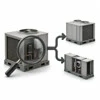
A commercial HVAC inspection and system assessment establishes a documented view of equipment, controls, distribution, operating context, and service risk. It can support maintenance priorities, acquisition review, capital planning, retrofit development, or replacement decisions. It does not automatically diagnose every active fault, design a future system, or provide contractor pricing. ClimateService defines the authorized assessment scope and evidence boundaries for Chicago properties.
The purpose determines the assessment depth
An owner may need a high-level portfolio screen, an asset-level condition review, support for a repair-versus-replace decision, due diligence, a capital roadmap, or project development. Define buildings, systems, access, records, operating modes, consequence, schedule, and deliverable before fieldwork. A broad visual survey cannot support the same conclusions as targeted testing and trend review.
Inventory creates the system context
Record equipment identity, location, served areas, capacity data, installation history where known, utilities, controls, distribution, redundancy, access, and relationships to other assets. Field evidence should be separated from record drawings and owner-provided information. Shared pumps, controls, air paths, and plant assets can make several equipment tags one operating system.
Condition observations need precise language
Cabinets, coils, heat exchangers, fans, motors, compressors, pumps, piping, valves, dampers, electrical components, controls, drains, insulation, filters, supports, corrosion, leakage, vibration, contamination, and access may be reviewed within scope. The record should state what was visible, measured, operating, inaccessible, shut down, or not tested rather than converting uncertainty into a pass.
Operating evidence adds meaning to appearance
Schedules, setpoints, alarms, trends, runtime, temperatures, pressures, airflow or water-flow evidence, utility context, tenant complaints, service history, repeated failures, refrigerant events, and temporary repairs can refine conclusions. Conditions during one visit may not represent peak cooling, heating, occupancy, or failure modes. The report should retain date, weather, load, and operating limitations.
System fit is different from equipment condition
An asset may be mechanically serviceable yet poorly matched to current occupancy, ventilation, zoning, schedules, humidity, controls, acoustics, redundancy, or future plans. Conversely, a comfort complaint may originate in distribution, sensors, envelope, operation, or load rather than equipment condition. The assessment separates these questions and routes design or diagnostics to responsible parties.
Controls receive both physical and operational review
Sensors, actuators, controllers, safeties, schedules, setpoints, stages, valves, dampers, alarms, overrides, network points, graphics, trends, and facility access may be relevant. Point verification or functional testing requires explicit scope. A screen image or local unit response does not prove that the complete sequence, feedback, and third-party interfaces operate correctly.
Risk combines condition with consequence
Priority should consider affected occupants and operations, redundancy, acceptable outage, season, parts and refrigerant constraints, temporary options, access, tenant obligations, and probable response time. Similar conditions may receive different priorities because failure consequences differ. The owner should approve risk criteria instead of treating an unexplained numerical score as an objective fact.
Safety and compliance observations have clear boundaries
Unsafe electrical conditions, combustion concerns, structural deterioration, refrigerant issues, water damage, blocked service access, and fire or life-safety interfaces may require isolation or specialist escalation. ClimateService records observations within its authority. Engineering, code interpretation, environmental investigation, testing, and authority approval remain with qualified responsible parties identified in the next step.
Recommendations should be specific and prioritized
Actions may include immediate risk control, maintenance, repair, diagnostics, monitoring, controls review, balancing, design investigation, retrofit development, replacement planning, or no current action beyond scheduled review. Each recommendation should name the asset, reason, evidence, uncertainty, responsible role, suggested timing, and trigger. It should not disguise a sales preference as a field conclusion.
An assessment is not a quote or complete diagnosis
A quote prices a defined contractor scope. Diagnostics investigate a specific symptom or failure. An assessment organizes broader system condition and decision evidence. These tasks can lead to one another but should not be merged. Detailed pricing requires current scope, design, equipment, trades, access, permits, logistics, controls, testing, and commercial terms.
ClimateService delivers a usable decision record
The final record can include scope, asset inventory, evidence sources, observations, operating context, photographs, limitations, priorities, recommended actions, and open questions. Facility teams can update it after repairs, testing, tenant changes, or capital decisions. The services below distinguish assessment from diagnostics and estimates, define coverage, review existing systems, and support replacement or retrofit choices.
Recommendations should also show dependencies between actions. A controls test may require a sensor repair; a replacement plan may require load review, roof investigation, or utility confirmation; a retrofit may depend on retained-equipment condition. Sequencing these prerequisites helps the owner avoid pricing or scheduling a project whose basic feasibility has not been established.
When conditions change, preserve the original date and evidence rather than silently rewriting the assessment. A dated update can document the new failure, repair, tenant use, access, or test result and revise priority transparently. This history makes the assessment more valuable for future service and capital decisions.