
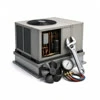
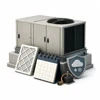

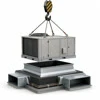
A commercial rooftop unit places heating, cooling, airflow, outdoor-air, controls, and safety functions in a weather-exposed cabinet connected to the building through a curb and duct system. The roof location simplifies some floor-space decisions but introduces access, weather, structural, roofing, drainage, rigging, and service-clearance conditions that distinguish RTU work from other packaged equipment.
Confirm the RTU and the area it serves
Equipment designation, model and configuration, heating source, cooling circuits, controls, economizer, curb, duct orientation, served zones, schedule, and service history establish the operating boundary. Roof maps and labels are often inconsistent. Confirming unit-to-zone relationships prevents work on the nearest cabinet from being assumed to address the reported space.
Choose the page that matches the RTU decision
Repair addresses an active fault. Maintenance follows a recurring equipment-specific scope. Replacement evaluates the present asset and changeout project. Controls and economizer service focuses on commands, sensors, dampers, actuators, sequences, and physical response. Installation and changeout covers equipment placement and building interfaces. Each dedicated page owns its narrower search and service intent.
RTU repair follows the reported function
Complaints can include no heating or cooling, weak airflow, uneven zones, repeated trips, water, ice, noise, odor, short cycling, poor outdoor-air behavior, or intermittent operation. Evaluation may include commands, safeties, fans, motors, belts, coils, compressors, refrigerant-circuit behavior, heating components, dampers, sensors, electrical conditions within the unit, drainage, and distribution.
A unit running at arrival may still have a load- or schedule-dependent fault. Alarm history, BAS trends, weather, occupancy, and the sequence before failure can preserve evidence that a reset would erase.
Roof access is part of the service scope
Access may require roof keys, ladders, hatches, escorts, fall-protection procedures, restricted areas, tenant notice, loading limits, and weather planning. Safe service also depends on clear paths, stable work surfaces, panel clearance, lighting, and the condition of surrounding roof assemblies. Access limitations should be identified during intake rather than discovered after dispatch.
Maintenance must account for outdoor exposure
A planned scope may address filters, coils, fan assemblies, belts, bearings, drains, safeties, electrical and control connections, heating, refrigerant-circuit observations, outdoor-air and economizer components, sensors, dampers, cabinet panels, seals, curb interfaces, and operating checks. Task depth depends on configuration, hours, environment, season, manufacturer guidance, access, and service history.
Controls and economizers require command-to-motion verification
Schedules, setpoints, outdoor-air and mixed-air sensors, damper commands, actuators, linkages, minimum position, enable logic, stages, and safeties can shape both ventilation and capacity. A BAS percentage does not prove actual blade position or airflow. Physical movement and resulting mixed-air behavior must be compared with controls intent.
Curb, ducts, and roof interfaces affect performance
Supply and return openings, curb alignment, gaskets, duct transitions, insulation, cabinet seams, roof penetrations, drains, and nearby exhaust or recirculation can affect air leakage, water, noise, and delivered capacity. Roofing or structural conditions outside the HVAC boundary require the appropriate responsible party, but their dependency should be documented.
RTU replacement begins with field verification
A changeout can require a curb adapter, duct modification, electrical or fuel changes, controls integration, drainage, crane planning, roof protection, structural review, permits where applicable, and temporary operating measures. Equipment dimensions, weight, connection locations, service clearances, lifting points, and delivery schedule should be confirmed before the shutdown.
Rigging and building operations share one plan
Crane position, street or parking control, roof loading, weather, swing path, equipment staging, tenant communication, shutdown sequence, trade presence, and a decision-maker can determine whether the changeout stays inside its window. The project scope assigns ownership for curb, roofing, duct, electrical, controls, gas, drain, disposal, and restoration work.
Startup and functional testing must reach the zones
Startup confirms connections, rotation, filters, drainage, utilities, manufacturer checks, and safe initial operation. Functional testing follows fan, heating and cooling stages, safeties, economizer, outdoor air, controls, alarms, and response in representative served zones. Mild weather may limit peak-load proof; that limitation belongs in the close-out.
RTU verification follows the original complaint
After repair, the technician may confirm stable cycles, temperature change, airflow, stage response, safety behavior, damper movement, drainage, controls, and improvement in the affected footprint. Startup alone is not enough when the failure occurred during a particular schedule transition, load, or zone interaction.
Prepare a rooftop unit request
Provide the property, unit designation, served areas, configuration if known, symptom, alarms, BAS history, recent work, roof access, weather or work-hour restrictions, and an authorized contact. Replacement or installation also needs curb and structural information, utility and controls contacts, rigging constraints, shutdown limits, and trade ownership.
Choose the correct rooftop unit resource
Use the dedicated pages for RTU repair, maintenance, replacement, controls and economizer service, or installation and changeout. General packaged units and self-contained units keep separate categories. Ventilation, controls/BAS, capital planning, and occupied-building installation pages retain distinct intent where the decision is broader than one rooftop unit.
Request commercial RTU service
ClimateService provides commercial rooftop HVAC unit service in Chicago and nearby suburbs. Complete equipment, access, controls, and zone information lets the request reach the correct repair, maintenance, replacement, economizer, or changeout path.