
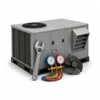
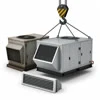
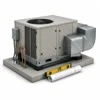
A commercial packaged HVAC unit places multiple functions in one factory-built cabinet. Depending on the application, that cabinet may include cooling circuits, heating, supply and return fans, filters, outdoor-air components, dampers, controls, safeties, and electrical sections. The unit is compact, but its service boundary still extends into ductwork, power, controls, drainage, gas or hydronic connections where applicable, and the occupied spaces it serves.
Identify the packaged-unit configuration first
Packaged equipment may be rooftop, grade-mounted, horizontal, vertical, gas/electric, heat-pump, cooling-only, or connected to specialized ventilation and controls. Nameplate information, model configuration, served area, duct orientation, controls architecture, access, and operating history help determine the correct service path. A visual match between cabinets does not prove identical internal components or capacity.
Route the request by service intent
Repair addresses an active fault or degraded function. Maintenance follows a recurring equipment-specific task set. Installation creates the equipment and building interfaces. Replacement evaluates an existing asset, the present application, available configuration, project dependencies, downtime, and acceptance criteria. Each dedicated page owns that narrower intent while this category explains the complete equipment family.
Packaged-unit repair follows the failed function
A complaint may involve no heating or cooling, weak airflow, uneven zones, nuisance trips, water, ice, noise, odor, short cycling, poor outdoor-air control, or intermittent operation. Evaluation can include commands, safeties, fans, motors, belts, coils, compressors, refrigerant-circuit behavior, heating components, dampers, sensors, drains, electrical conditions within the unit, and connected distribution.
The nearest component is not always the cause. A controls command may not produce physical response, airflow can affect refrigeration or heating behavior, and distribution can lose a useful result before it reaches the space. Tests are selected from the symptom and installed configuration rather than from a universal parts list.
Maintenance must cover applicable cabinet sections
A planned scope may address filters, coils, fan assemblies, belts, bearings, drainage, safeties, electrical and control connections, heating operation, refrigerant-circuit observations, outdoor-air and economizer components, sensors, dampers, cabinet condition, and operating checks. Tasks depend on equipment type, operating hours, environment, manufacturer guidance, season, shutdown access, and service history.
Outdoor air and economizer operation need physical confirmation
A damper command or BAS position does not prove actual blade movement, linkage condition, actuator response, sensor accuracy, or usable outdoor airflow. Outdoor-air components can influence ventilation, capacity, freeze exposure, humidity, pressure, and energy use. Their scope should distinguish mechanical condition, controls sequence, air balance, and code or design responsibility.
Drainage and cabinet condition protect the building interface
Condensate pans, traps, drains, cabinet seams, insulation, access panels, curb or pad condition, and duct transitions can affect water management and air leakage. A leak may originate inside the unit, at a connection, from ice, or from a building interface outside a narrow equipment repair. The supported source determines ownership and correction.
Installation begins with application and interfaces
Selection considers load, ventilation, heating source, efficiency and refrigerant requirements, dimensions, weight, service clearances, supply and return orientation, curb or pad, duct transitions, electrical capacity, gas or hydronic connections, drains, controls, rigging, structure, and operating schedule. The project scope assigns trade responsibility before mobilization.
Replacement is not only a cabinet swap
A replacement may require adapters, duct changes, curb or support work, controls integration, electrical or fuel changes, drainage, crane or access planning, roof protection, temporary conditions, startup, and later seasonal verification. A nominally similar unit can place connections and service clearances differently. Field verification reduces improvised work during the outage.
Startup and functional testing are separate steps
Startup confirms readiness, rotation, connections, manufacturer-required checks, and safe initial operation. Functional testing confirms that schedules, fan, heating and cooling stages, outdoor-air functions, dampers, safeties, controls, drainage, and connected zones respond as intended. The acceptance criteria should be agreed before the installation or replacement window.
Verify the result at the unit and occupied boundary
Repair verification may include stable operation through a call, appropriate temperature change, airflow, stage response, control and safety behavior, drainage, and improvement in the affected space. Full-load performance may not be available during mild weather. The close-out should state what conditions were tested and what remains conditional.
Prepare access and operating information
Share the equipment designation, configuration if known, served areas, symptom, alarms, BAS history, recent work, roof or grade access, shutdown restrictions, tenant schedule, and an authorized site contact. Installation or replacement also needs drawings when available, utility and controls contacts, equipment path, structural or curb information, and trade coordination.
Choose the correct packaged-unit page
Use the dedicated pages for packaged HVAC unit repair, maintenance, installation, or replacement. Rooftop units and self-contained units retain their own categories because those searches and field conditions deserve separate ownership. Broader controls, ventilation, replacement planning, and capital pages remain distinct to avoid duplicating the same decision intent.
Request commercial packaged HVAC service
ClimateService provides packaged commercial HVAC unit service in Chicago and nearby suburbs. Complete equipment and building information helps route the request to repair, maintenance, installation, or replacement without forcing the facility through an unrelated service path.