
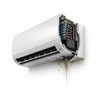
A mini-split that cools poorly, drips water or displays an error code is reporting something specific. Inverter equipment carries its own diagnostics, communicates between the indoor head and the outdoor unit, and logs faults that a ducted system has no way to record. Reading that information is where the visit starts.
Failure Modes Specific to Ductless Systems
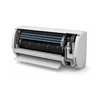
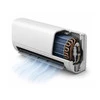
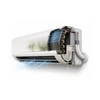
The architecture is what makes the failures different in the houses we see around Chicago. There is no duct system and no central blower. Each indoor head contains its own fan, coil, filters and drain, and it communicates with a variable-speed outdoor unit over a control line that carries both power and data.
That produces a failure list a furnace technician does not encounter: communication errors between head and outdoor unit, inverter board faults, blocked condensate at the head with no drain pan below it, and fouled blower wheels inside a unit hanging on a living-room wall. Refrigerant faults still occur, and they present through the equipment's own codes before they present as weak cooling.
Indoor Head Cleaning and What the System Needs Between Visits
The indoor head does the work a duct system and a filter rack do elsewhere, in a fraction of the space. Its washable pre-filters catch the coarse material, and everything finer reaches the blower wheel and the coil behind it.
A loaded blower wheel reduces the CFM crossing the coil, which drops capacity and raises the chance of condensate blowing off the coil before it drains. The visible symptom is often a smell or a drip, with cooling capacity falling more quietly. Pre-filters are homeowner-serviceable; the wheel, the coil and the drain line are service work, because reaching them means opening the head and disturbing the refrigerant and electrical sides.
Condensate, Line Sets and Drainage
In the older housing stock around Chicago, water leaves an indoor head by gravity through a drain line inside the line-set sleeve, or by a small pump when gravity is unavailable. Both routes fail quietly. A slow drain backs water into the head and out through the louvers, and a failed pump does the same faster.
The line set itself carries refrigerant, the drain and the control wiring through one wall penetration. Its condition matters for all three: insulation degraded by sun on an outside wall causes sweating along the run, and a sagging drain section holds water and grows a blockage. Both are found by inspection during seasonal service.
Reading Error Codes Before Opening Anything
Mini-split systems report faults through the head display, an indicator light sequence, or the outdoor board. The same code does not always mean the same thing across manufacturers, and multi-zone systems from Mitsubishi, Daikin, LG and Fujitsu each use their own conventions for numbering and for how the head and outdoor unit exchange data.
What a code gives is a starting point and a record. A communication error narrows the search to the control line, its terminations and the boards at both ends. A refrigerant-side code narrows it to pressures and temperatures that then get measured: superheat and subcool at the service port, coil temperatures at the head, and current draw at the outdoor unit. Clearing a code without finding its cause loses the only evidence the system produced.
Multi-Zone Systems: One Outdoor Unit, Several Symptoms
A multi-zone system connects several indoor heads to one outdoor unit, and that changes diagnosis. A fault in one head can affect the behavior of others, because they share a compressor and a refrigerant circuit. One head that will not cool may be reporting its own valve, or it may be showing the effect of a problem elsewhere in the system.
The diagnostic sequence therefore covers the whole circuit before any single head is opened. Which heads are calling, what each reports, and how the outdoor unit responds together identify whether the fault is local or shared.
The Same Machine Also Heats
A ductless system with a reversing valve is a heat pump, and the equipment cooling a room in July is the equipment heating it in January. Faults in heating mode point at parts cooling mode never uses: the reversing valve itself, defrost control, and the outdoor coil under frost conditions.
Reporting which mode the fault appears in narrows the search considerably. A system that cools correctly and heats poorly is a different investigation from one that fails in both modes.
Outside the Scope of a Repair Visit
Ducted central air conditioning fails through different components and is covered on central AC repair. Adding heads, replacing a system or extending an existing one to a new room is planning work, and it starts at ductless installation. A house where both the furnace and the cooling side misbehave through shared ducts belongs on whole-system HVAC repair. The section routing table is on the cooling hub.
What to Check Before Booking a Visit
- Any code or indicator sequence shown on the head, written down in full before the unit is switched off at the breaker or the remote.
- Which heads are affected and which are normal, on a multi-zone system.
- Whether the fault appears in cooling, in heating, or in both modes.
- The condition of the washable pre-filters and when they were last rinsed.
- Whether the outdoor unit runs at all, and whether its speed varies during operation.
Pre-filter cleaning is safe from the homeowner's side. Opening the head, handling the drain line or working at the outdoor unit is technician work, since the refrigerant circuit is pressurised and the control line is live. Emergency calls are taken around the clock, same-day service is available when a slot is open, and our workmanship is backed by a labor warranty.