
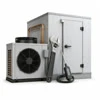
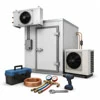

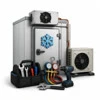
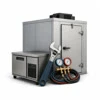
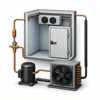
Commercial refrigeration is a fixed-site system that connects the refrigerated space or fixture with evaporators, condensing equipment, refrigerant piping, controls, drainage, doors, insulation, power, and heat rejection. A temperature complaint can originate in the refrigeration circuit, but it can also be sustained by airflow, defrost, door traffic, product loading, sensors, seals, drainage, controls, or the surrounding building.
This category covers stationary refrigeration
The scope includes building-based walk-in coolers and freezers, reach-ins, preparation and undercounter equipment where serviceable, display cases, ice-related refrigeration components where applicable, remote condensing systems, and restaurant refrigeration. It does not cover truck, trailer, transport refrigeration unit, or roadside reefer service; those belong to the separate transport-refrigeration section.
Choose the service by the decision required
Repair addresses an active failure or degraded temperature control. Maintenance follows a recurring equipment-specific scope. Installation creates the box, equipment, piping, power, controls, drainage, ventilation, access, and startup project. Walk-in cooler, walk-in freezer, and restaurant refrigeration pages own their narrower equipment and operating intents.
Protect product while preserving technical evidence
The facility remains responsible for food-safety, product-disposition, inventory, and operating decisions under its procedures. During intake, report actual product and air temperatures when reliably measured, alarm times, trend, door activity, recent loading, affected equipment, and the consequence of continued operation. Do not repeatedly reset a tripping system or change multiple controls before the service condition is recorded.
Fault isolation follows the refrigeration path
Evaluation may include the control demand, sensors, safeties, evaporator fans and coil, defrost, drains, expansion control, compressors, condenser coil and fans, refrigerant-circuit evidence, valves, piping, electrical conditions within the equipment, and heat-rejection environment. Tests are selected from the symptom, system architecture, and operating state.
Ice, low temperature, high temperature, noise, water, oil trace, short cycling, and an alarm are evidence rather than complete diagnoses. The supported cause must connect those observations with equipment response.
Walk-in boxes are part of the operating system
Doors, closers, gaskets, sweeps, hinges, thresholds, panels, vapor seals, penetrations, lighting, floor, product clearance, shelving, and traffic can affect load and moisture. Refrigeration repair may identify a box or door dependency without automatically including carpentry, flooring, food-safety, or structural work. Ownership and follow-up should be explicit.
Airflow and product loading affect evaporator performance
Blocked air return, product placed against the coil, damaged fan guards, fan failure, loaded coils, packaging debris, and altered shelving can create uneven temperature. Service compares evaporator condition with the stored-product arrangement and space response. The facility should preserve safe access and identify recent loading or layout changes.
Defrost and drainage require sequence-based checks
Timers or controllers, termination sensors, heaters or hot-gas components where applicable, fan delays, safeties, drain pans, drain heaters, traps, and drain routing can affect ice and water conditions. A manual defrost may change the symptom without correcting the driver. Verification should include the relevant transition when safe and practical.
Remote condensing equipment depends on its environment
Condenser airflow, coil condition, fan operation, ambient temperature, recirculation, clearances, oil management, piping, receiver and controls where installed, electrical supply, and neighboring heat sources can influence system operation. Roof, yard, or mechanical-room access should be provided along with access to the refrigerated space.
Maintenance should reflect equipment and use
A planned scope may address applicable coils, fans, filters where installed, drains, defrost, controls, sensors, safeties, electrical connections, refrigerant-circuit observations, doors and gaskets, piping insulation, condenser environment, and operating checks. Frequency depends on equipment type, hours, kitchen grease or dust, door traffic, product load, environment, manufacturer guidance, and service history.
Installation starts with application and heat rejection
Planning considers target conditions, product and use, load, box or fixture, doors, evaporator placement, condensing equipment, piping length and elevation, refrigerant requirements, power, controls, drainage, ventilation, structural support, penetrations, access, noise, service clearances, permits where applicable, and trade responsibilities. Restaurant schedules and occupied operations can control phasing.
Startup and verification must reflect the stored-space result
Startup confirms readiness, airflow, controls, drainage, piping documentation, charge process, safeties, and initial operation. Functional testing may follow pull-down, temperature control, defrost, fan sequence, alarms, door recovery, condenser behavior, and representative space conditions. Product loading and operating procedures can limit what is proven during an empty startup.
Prepare a refrigeration service request
Provide the property, equipment and box designation, current and target conditions, alarm history, product impact, door and loading activity, recent work, active ice or water, access to evaporator and condensing equipment, operating restrictions, and an authorized contact. Safe photographs can help identify equipment without requiring staff to open technical panels.
Choose the correct refrigeration resource
Use dedicated pages for fixed-site refrigeration repair, installation, maintenance, walk-in cooler service, walk-in freezer service, or restaurant refrigeration. Controls, ventilation, make-up air, kitchen HVAC, capital planning, and transport reefer services retain separate intent when the decision extends beyond stationary refrigeration equipment.
Request fixed-site commercial refrigeration service
ClimateService provides commercial refrigeration service in Chicago and nearby suburbs. Clear information about the box, equipment, temperature trend, product exposure, controls, access, and operating schedule helps route the request to the correct repair, maintenance, installation, or equipment-specific path.