

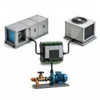
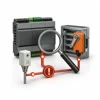

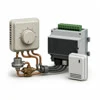
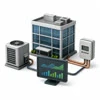
Commercial HVAC controls and building automation coordinate equipment, distribution, schedules, sensors, sequences, alarms, and operator decisions across a facility. A BAS or BMS can provide visibility and control, but a screen value does not prove physical performance. ClimateService supports authorized Chicago controls-first work and coordinates mechanical evidence while generic equipment repair, cybersecurity, life-safety, engineering, and owner governance retain clear boundaries.
Use this category when the intent is controls-first
This section owns building automation service, BAS and BMS support, HVAC controls integration, controls troubleshooting, sensors and control devices, BAS retrofit, DDC upgrades, pneumatic-to-DDC conversion, and BAS-linked remote monitoring. A compressor, chiller, RTU, VRF, boiler, or tower problem remains in its equipment branch when controls are secondary.
Commercial BAS and BMS service
Ongoing service maintains usable access, point integrity, schedules, alarms, trends, backups, documentation, controller and device condition, and coordination with physical HVAC operation. The goal is operational continuity and clear issue routing, not a blanket promise that automation prevents every equipment or occupant problem.
HVAC controls integration
Integration connects new or existing equipment to approved controls through point mapping, wiring or communication, sensors, commands, status, safeties, alarms, graphics, schedules, sequences, testing, and turnover. It is project-level controls ownership, distinct from installing the mechanical equipment itself or performing generic commissioning.
Controls and BAS troubleshooting
Troubleshooting starts with a defined behavior and traces it through schedule, command, controller, output, relay or network, actuator, sensor, equipment, distribution, and occupied result. It separates automation faults from valid protective responses and mechanical conditions. Device-level sensor and actuator work becomes its own narrower route when appropriate.
Sensors and control devices
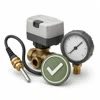
Temperature, humidity, pressure, flow, air-quality, current, status, valves, dampers, actuators, relays, drives, and other devices require correct location, range, installation, wiring, calibration, feedback, and physical verification. A plausible value can be wrong if it represents the wrong medium, mounting condition, scale, or point.
BAS retrofit and modernization
Modernization replaces unsupported or fragmented automation through an inventory, sequence review, network and panel strategy, point migration, device decisions, graphics, histories, alarms, access, phasing, backups, testing, and operator training. Broad plant modernization stays outside this category unless automation is the primary project owner.
Commercial DDC controls upgrades
DDC upgrades address controllers, input and output capacity, panels, power, networks, programming, sensors, devices, point naming, trends, alarms, and interfaces. They are narrower than a complete BAS retrofit and should preserve approved sequences and serviceable field devices where evidence supports reuse.
Pneumatic-to-DDC conversion
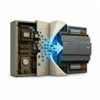
Legacy pneumatic controls involve compressors, dryers, mains, branches, thermostats, transmitters, actuators, valves, dampers, calibration, leaks, and mechanical linkages. Conversion requires a zone and device map, decisions about retained actuation, electrical pathways, sequences, phasing, testing, and removal or documentation of abandoned tubing.
Remote monitoring and energy benchmarking
Monitoring uses reliable points, trends, alarms, schedules, metadata, baselines, operating context, review responsibilities, and response workflows. Benchmarking supports investigation and prioritization but does not diagnose every cause or guarantee savings. Mission-critical monitoring and generic energy studies remain separate when BAS/HVAC controls are not the primary owner.
Controls work must reach physical equipment
Commands, graphics, status, and trends should be compared with fans, pumps, valves, dampers, compressors, heat, airflow, water, temperatures, pressure, and zones. Digital completion without physical response can leave a facility with polished graphics and unchanged operation. Mechanical and controls teams should exchange evidence rather than assumptions.
Changes require governance and rollback
Authorized access, backups, version records, reason, approval, affected systems, risk, test plan, rollback, schedule, communication, and final settings should accompany material changes. Overrides need owners and expiration. Network security and account policies remain with responsible facility and technology parties, not improvised during HVAC service.
Choose the correct service route
Use BAS/BMS service for ongoing system ownership, integration for connecting systems, troubleshooting for malfunction, sensors and devices for a narrowed field problem, retrofit for broad modernization, DDC upgrade for controller-focused renewal, pneumatic conversion for legacy air controls, and monitoring for ongoing BAS-linked visibility. Clear routing prevents overlapping pages and duplicated scope.
ClimateService provides controls work with a usable handoff
ClimateService documents system boundary, complaint or project goal, assets and points, intended sequence, observations, settings, changes, backups supplied, physical tests, restored overrides, limitations, open mechanical or BAS work, and follow-up within its scope. Facility teams receive traceability while engineering, network, life-safety, compliance, and owner decisions stay explicit.
Start with the service that owns the primary problem
A controls-first request should name the behavior, affected equipment or spaces, operating consequence, timing, recent changes, available BAS access, and responsible facility contacts. That information helps route ongoing service, integration, troubleshooting, device work, or modernization correctly. When evidence instead points to refrigeration, hydronics, airflow, power, or equipment failure, the controls record supports a clean handoff without duplicating another service page.